The Oscilloscope
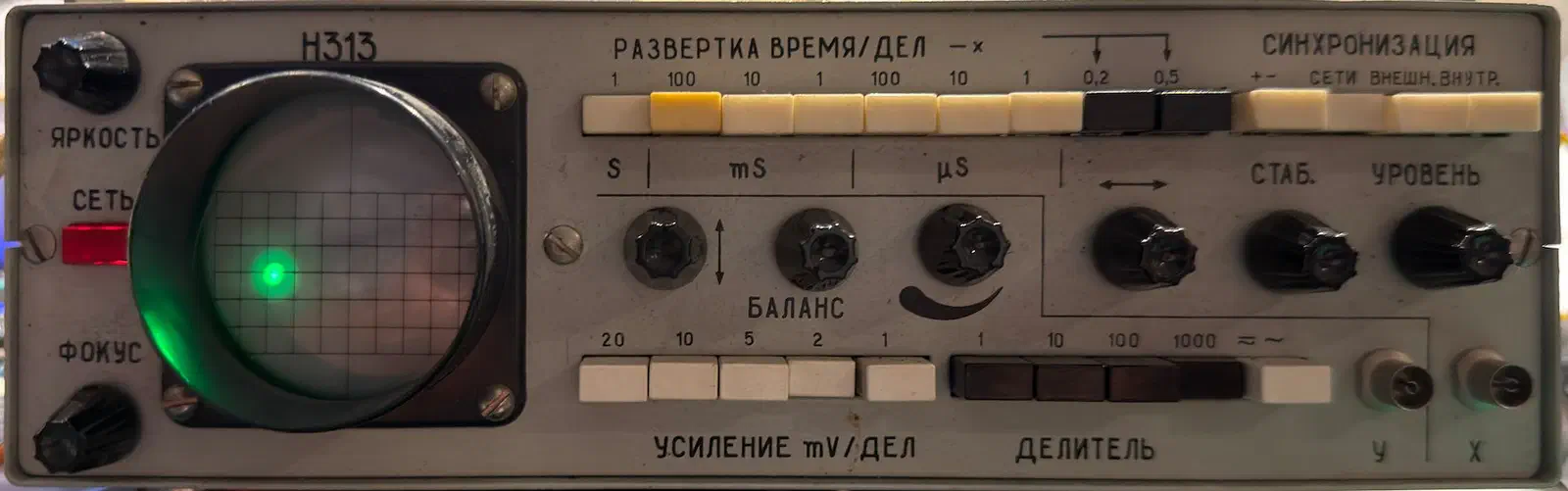
Somewhere in the general mess that masquerades as my electronics workbench, there is a small instrument that looks somewhat out of time. It’s a Soviet N313 (Н313 in Cyrillic) oscilloscope, in a compact metal case, with Cyrillic labels, clicky buttons and some dials. Its most prominent feature is the 45 mm circular cathode-ray tube, with a thin transparent graticule on top that tends to move around when nobody’s looking.
When I turn the oscilloscope on, nothing happens for a few seconds – except that the “СЕТЬ” button (literally “mains”) glows red. If I’m lucky, I see a faint green glow somewhere on the CRT.
Over the next few seconds, the glow intensifies. The “ФОКУС” (focus) control turns it into a green dot.
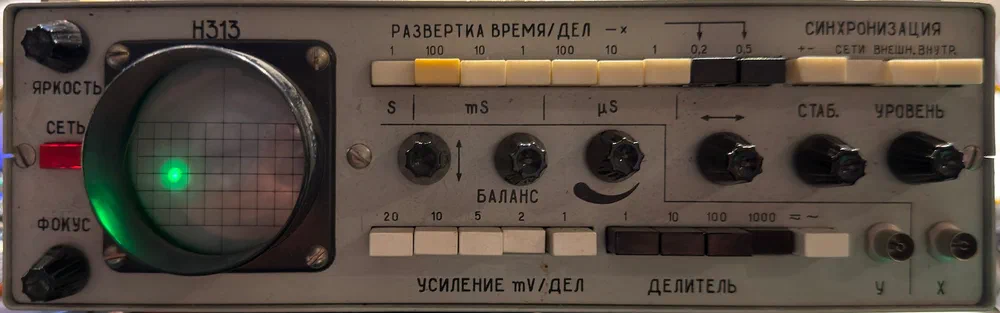
I received this oscilloscope from a colleague. He rescued it from the family home in Germany when his father moved into a care home. It had belonged to his father, an instrumentation specialist originally from Czechoslovakia.
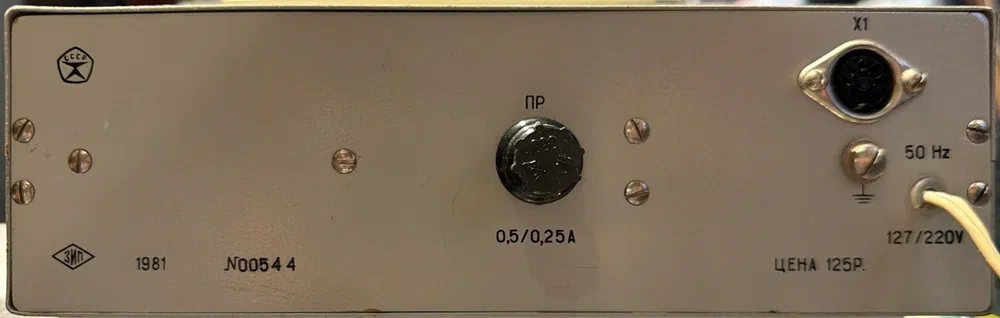
Reading the object is – for once – refreshingly straightforward, as all the information is silkscreened right on the case:
- Model Н313 (N313 in Latin characters)
- Manufactured in 1981
- Serial number 00544
- Soviet State Quality Mark
- ЗИП manufacturer’s mark – built by the Krasnodar Electrical Measuring Instruments Plant
- 50 Hz and 127/220 V
- Price: 125 roubles
1981. Fifty hertz. 127 or 220 volts. 125 roubles. The price is actually printed on the back of the case, as if it were part of the specification: ЦЕНА 125 Р.
I can’t give an exact equivalent for 125 roubles in Swiss francs or euro in 1981: the rouble wasn’t freely convertible, and the euro hadn’t been invented yet. What I can say is that 125 roubles was roughly three quarters of the average Soviet monthly wage.
I don’t actually use the Н313 for measurements. It uses an obscure Soviet connector for its probes, and I don’t have any that fit.
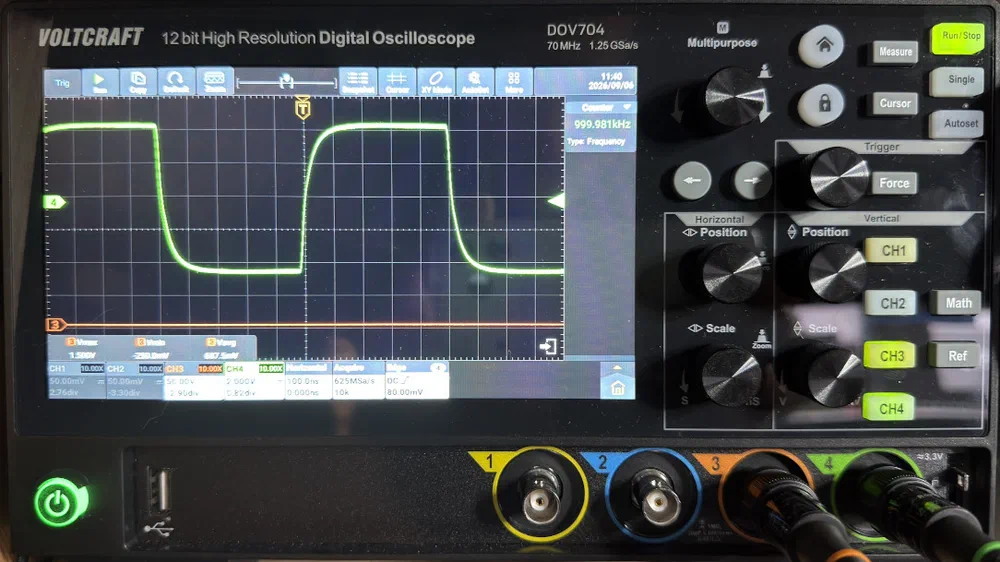
The oscilloscope I actually use is a Voltcraft DOV704. It gives me a comparatively enormous colour touchscreen, automatic measurements, greater accuracy, readily obtainable probes and considerably more convenience.
The old one has only one advantage.
Why the Oscilloscope Belongs to Enkataleiptics
I’ve been asked why there is an electronic instrument in a logo of a website about abandoned buildings. The explanation is easy: it belongs there.
Enkataleiptics is easily mistaken for an interest solely in derelict buildings. While buildings are often its most visible subjects, the field goes deeper. The actual concern of enkataleiptics is – as the tagline under the logo states – “documenting what remains”. What remains can be a factory, a hospital or the foundations of a bunker, but it can also be a fragment, a small inscription, a personal history, or, indeed, an instrument.
The Н313 is not derelict. It still works. I simply lack the obscure probes needed to use it for measurements. Nevertheless, it preserves evidence of a vanished technical, industrial, economic and political world. Its manufacturer has ceased production, the factory complex has been repurposed, even the country where it was produced no longer exists. The surviving instrument provides a physical connection between the Soviet Union, that vanished factory in Krasnodar, a Czechoslovak instrumentation specialist, and my present workbench.
And on my present workbench it still sits: an obsolete instrument with no practical use to me. From time to time, I switch it on anyway, wait a few seconds, and watch the green dot appear from across the decades.
It always makes me smile.
That is why there is an oscilloscope in the logo.