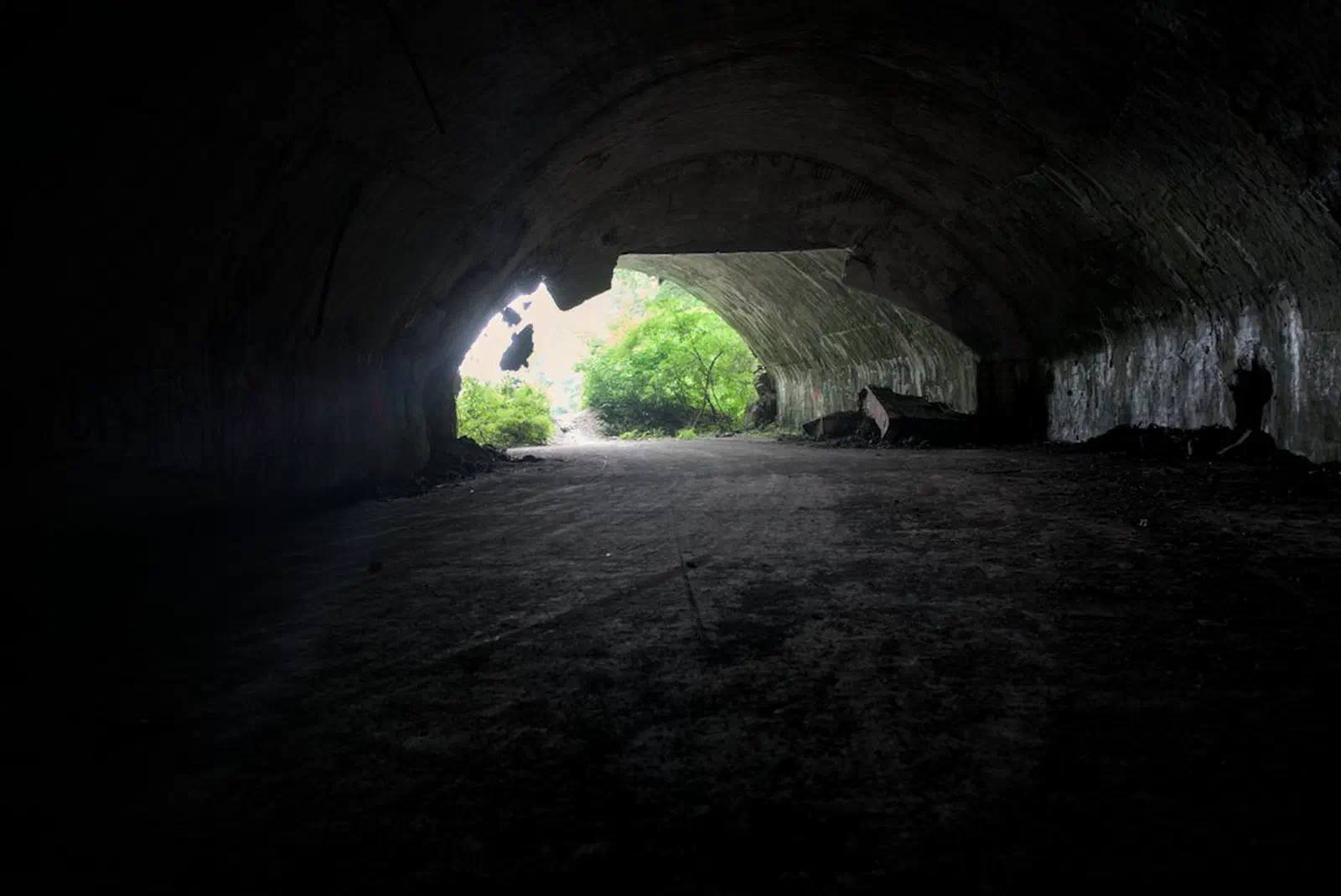
On my recent field trip to Croatia, I visited one of the country’s arguably most famous abandoned sites: Željava airbase. Built beneath Mount Plješevica on what is now the Croatian–Bosnian border, the former Yugoslav Air Force installation – codenamed Objekat 505 – combined several runways with roughly 3.5 kilometres of underground aircraft galleries (known as Klek 505), maintenance areas and command facilities. Completed in the late 1960s, it housed two fighter squadrons and a reconnaissance squadron, principally equipped with variants of the MiG-21. The complex was deliberately destroyed during the wars accompanying the breakup of Yugoslavia on May 16, 1992, leaving its runways cratered and almost all of the underground infrastructure burnt, blasted and stripped.
I had read up on the site beforehand, and there is a good amount of information available on the web. There are guided tours, there is the LYBI group of enthusiasts (LYBI was Željava’s Yugoslav ICAO location indicator) with a website that looks straight out of the 90s, and countless people have published photos and written texts about the scale, the cost and the capabilities of the installation. Very many of these texts point out that the underground installation “could feed 1,000 people simultaneously, along with stores of food, fuel and arms sufficient to last 30 days” (quoted from Wikipedia here).
Infrastructure week!
That is some serious infrastructure. We would be talking about substantial kitchens and mess halls, accommodation for a very large underground workforce, and all the associated facilities: food stores, washing areas, toilets, sewage systems and much else besides.
There is also a problem.
I don’t believe it.
Altogether, I have walked the entire tunnel system at least three times. On the first pass, I had little idea what was where and oriented myself by the graffiti on the walls: I came in at the pink skull, so it was right at “free Thai massage →”. I did recognise some rooms - the one with the floor covered in 120mm reconaissance film and a lonely bottle of developer was clearly the photographic laboratory. The empty tiled room with remnants of a cooling system on the wall I identified as the morgue. Mostly, however, there were just massive tunnels branching off from one another – so immense that my most serious torch, which had roughly the size and subtlety of a naval searchlight, could not reach their ends.
The high humidity did not help. Focusing the beam gave me a passable replica of a lightsaber, but not much additional visibility.
Just as I began my second pass, I came across a tour group taking a break and asked the guide whether my interpretations so far had been correct. They had, and he let me photograph the map he was using on his phone.
Star Command
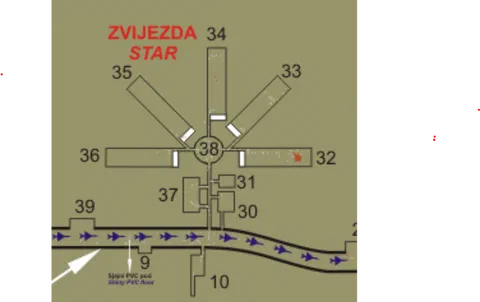
I then discovered that the place where I had started worrying about becoming lost – and had made a particular effort to memorise the graffiti – was called Zvijezda: “The Star”, or “Star Command”, on account of its shape. A relatively narrow corridor leads into a circular room, from which five further rooms branch off.
The map labelled room 37 as “Kitchen/Dining Room”. On a second look, this made sense. Among the ubiquitous heaps of debris are the remains of a single cooker. During an impromptu guided tour that I later gave to a couple of healthcare professionals from Luxembourg (drop me a line if you are reading this!) we also found shards of porcelain plates and half a glass ashtray in the rubble.
Now look at the size of this kitchen. The map is broadly to scale.
There is no plausible way that this room, as shown, could have prepared and served meals for a thousand people simultaneously. I have previously served – among other things – as an army cook in Switzerland, and the kitchen we used to feed between 100 and 200 people was larger than this one. It did not have to contain the dining room as well.
Let’s do some numbers. Assume that half the room – about 25 m² – was used as the dining area. The conditions need not have been especially cosy, so let us cram thirty people into it at a time. If they could enter, receive their food, find a seat, eat, clear their dishes and leave within fifteen minutes, feeding 1,000 people a single meal would require thirty-four sittings and take eight and a half hours.
There is not enough time in the day for everyone to eat three meals. Even if we tried to compress the three meals into twenty-four hours, the kitchen – the remaining 25 m² – would have to restock, prepare, cook and serve food while simultaneously cleaning the room and washing dishes, continuously, around the clock. From my experience, producing even 200 meals in a larger kitchen would not be remotely possible at that rate.
One word in the previous paragraph deserves more attention: “restock”.
One thousand people over thirty days amounts to 30,000 person-days of food. Using austere military provisions, a reasonable estimate would be around 0.6 kg of dry or preserved food per person per day. That means storing roughly eighteen tonnes of food – a little more than will fit in the average kitchen cupboard.
Depending on the packaging and the mixture of sacks, tins, dried goods and preserved foods, the provisions alone might occupy approximately 35–50 m³. A storage manager who was also a world-championship Tetris contender might conceivably compress them into that volume. A usable storeroom, however, would also require shelving, aisles, stock-rotation space, access to each category of food, separation from the damp walls, and room for receiving and moving supplies. I would therefore expect at least 85–100 m² of floor space: roughly twice the size of the entire kitchen and dining room.
These stores would need to be adjacent to, or at least close to, the kitchen to keep the supply routes manageable. Yet there is no room labelled “Food Storage”, or anything similar. In fact, there appears to be no such room anywhere on the map.
And while we are discussing missing rooms, there is no accommodation marked anywhere on the plan either.
Sleeping Space
Even under extreme assumptions – three-tier bunks and ship-like conditions – I estimate that housing 1,000 people would require at least 1,500 m² of sleeping space. That figure includes no toilets, showers, lockers, laundry rooms, medical facilities or substantial circulation space. It is the equivalent of fifteen rooms measuring 10 × 10 metres, packed to an almost implausible density – or more realistically, twenty or more rooms of that size.
None appears on the map.
It is possible that parts of the underground complex are no longer accessible, although I saw no obvious blocked galleries, collapsed branches or unexplained dead ends. What seems extremely unlikely is that an entire accommodation section large enough for a thousand people has vanished while most of the operational structure remains accessible in one form or another.
So, how can we explain the “1000 people for 30 days” story?
One part is certainly repetition. One early source (possibly even a Yugoslav military document or a post-war Croat/Bosnian heritage writeup) stated the 30-day/1000-person figure, and the wording has since been copied verbatim across every travel blog, Wikipedia, and dark tourism site, apparently without anyone checking it against the physical evidence. A classic case of – most probably unintentional – citation laundering.
But why did this early source make that claim in the first place?
Vojarna
I have one possible explanation: Željava could actually accommodate, feed and even entertain around a thousand people – just not underground.
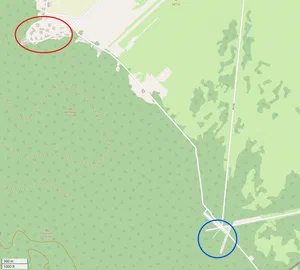
On the map to the left, the area circled in red contains a large group of twenty-one abandoned buildings; the blue circle marks the tunnel entrances for reference. Despite what the map suggests, the buildings have now been swallowed by the forest to such an extent that most are invisible from the road unless you know where to look. Most visitors to Željava drive straight past them.
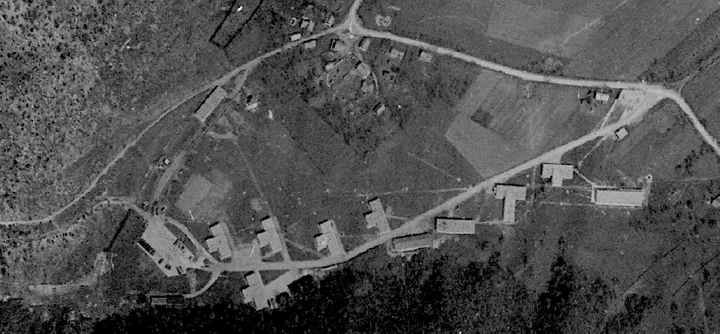
This was the vojarna: the barracks and support complex. The base village, in effect.
I explored the vojarna and found several buildings containing troop accommodation, showers and toilets; a large institutional kitchen and an enormous mess hall; several substantial workshops; an administration building; and even a cinema. Everything had been emptied and stripped, down to the light switches, but the buildings remained remarkably readable.
Twenty-one buildings provide ample room for barracks, kitchens, dining facilities, administration, workshops, recreation and the other services required by a large military establishment. I cannot derive an exact capacity from the surviving structures alone, but a base population of around a thousand people is entirely plausible. The vojarna looks like a place built to accommodate that order of magnitude. Klek 505 does not.
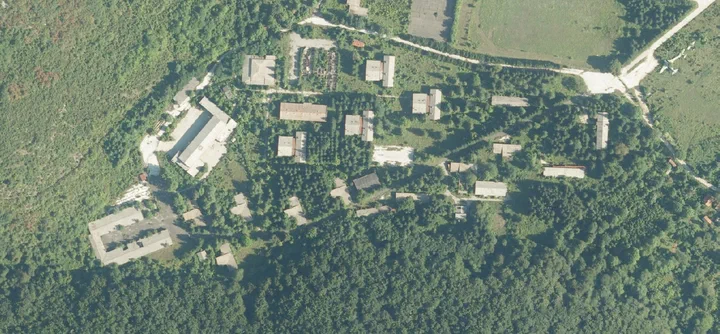
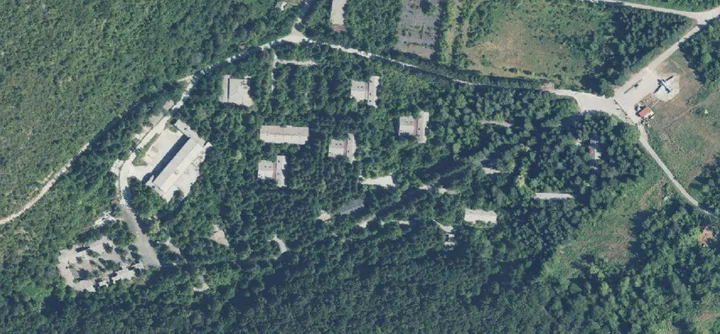
This suggests a fairly simple origin for the story. Željava may have had a total complement of roughly a thousand personnel. The underground installation may also have held fuel, weapons and other supplies intended to sustain combat operations for thirty days. Somewhere in the chain of retelling, those separate facts appear to have been joined together: a thousand people became a thousand people underground, and thirty days of operational reserves became thirty days of complete underground self-sufficiency.
Once combined, the claim acquired the satisfying shape of a Cold War superlative. It was precise, dramatic and entirely suited to a place like Željava. It was then repeated often enough to become accepted description.
I cannot prove that this is exactly how the myth arose. Perhaps an original plan, inventory or military report will eventually surface and show that I have overlooked something. Much of the installation was destroyed, stripped or altered, and absence of surviving evidence is not absolute proof that something never existed.
But extraordinary infrastructure leaves ordinary traces. A kitchen capable of feeding a thousand people, stores containing eighteen tonnes of food, and accommodation extending over thousands of square metres should remain visible in the layout even after the equipment has gone. In the underground complex, those traces are not merely damaged or ambiguous. They are simply not there.
Above ground, meanwhile, they are still standing among the trees.
My conclusion is therefore not that Željava could never support a thousand people, nor that it lacked reserves for prolonged wartime operation. Both are entirely credible. What I do not find credible is the familiar claim that a thousand people could be housed and fed inside the mountain for thirty days.
Željava does not need that story. What was actually built beneath Mount Plješevica is impressive enough.