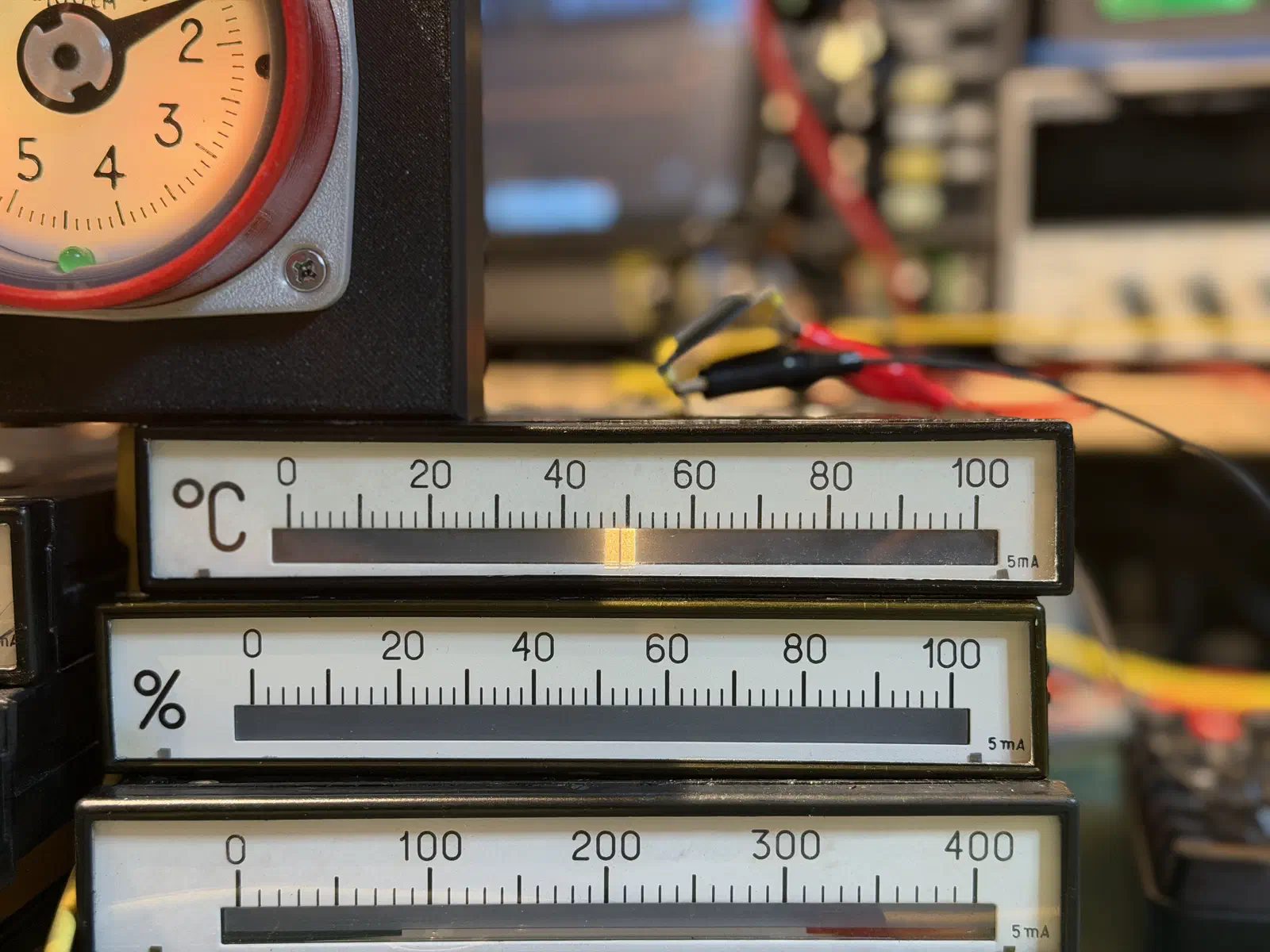
M1730
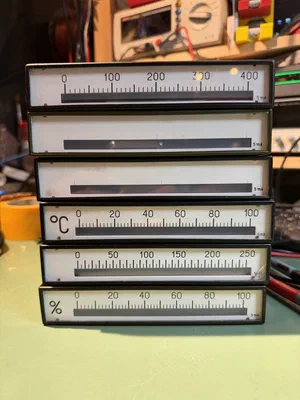
In the last post, I wrote about the M1730 ammeters: Soviet measuring instruments originally manufactured, tested, and certified for nuclear power plant use around 35 years ago. They are ammeters, but with the right sort of magic, they can display pretty much anything.
After a rather improbable journey from Ukraine to Switzerland – including a brief detour through false accusations of transferring money to a sanctioned Russian politician – a box of Soviet nuclear-power-plant instruments ended up on my workbench. They had stayed in their packaging long enough. It was time for them to do some work.
Home Assistant
I’ve been building a smart home setup for a while, which over the years has taken over more and more control and measurement duties around our house – to the occasional amusement, and sometimes slight exasperation, of my significant other.
So I decided that the meters could be used to display information from Home Assistant.
One of them almost determined its purpose by itself. Its scale is marked in °C, so that one is going to show the temperature of the boiler.
Fiat Lux
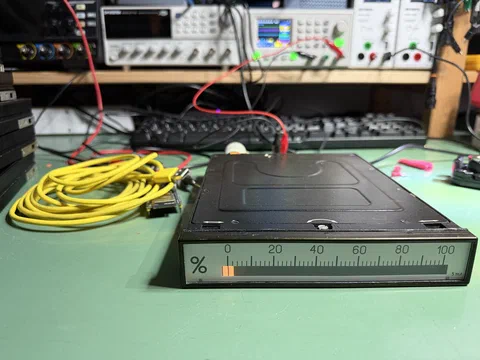
As mentioned before, the M1730 really only knows current, not temperature. So I needed a way to generate this accordingly. This is when I usually reach into the big box of microcontrollers and pull one out at random… This time, I got an ESP32-S3. That’ll do.
But first, I had to check how these meters can actually be controlled. They have 6 metal blades and one large spike coming out the back. Conveniently, they have instructions printed on the bottom, in the international language of electronic symbols. So blade 1 and 2 are AC/DC for the light source, 3 is earth, 7 and 8 are for the DC only galvanometer that measures the current.
Let there be light. Connecting the lamp pins to 6 V DC brought the indicator on the first test meter to life. Sending a small current of about 2 mA through the measuring input, did… absolutely nothing. I tested another meter, this one worked as expected.
So yes: 35 years in storage seem to have taken their toll on some of them. A quick diagnostic showed that the non-working ones have internal resistances of several megaohms or an open circuit, while the working ones measure at about 17Ω. I quickly tested all six units. Four of them seem to have survived their long hiatus.
Temperature to Current
Going back to a working unit: how do I vary the current going through the meter?
Quite simply - by varying the voltage and pushing it through a suitably sized resistor in series. Using Ohm’s law, the meter’s internal resistance, and an important additional scientific factor – namely what happened to be lying on my desk at the time – I went with a 450 Ω resistor.
At 3.3 V from the ESP32, this would overshoot the meter’s intended range a little ( \( \frac{3.3\text{ V}}{450\ \Omega + 17\ \Omega} \approx 7\text{ mA} \) ), but that can be limited in software. The meter is slow and mechanical enough that a PWM signal works nicely as a controllable average current. No need to muck about with op-amps or stabilised voltages.
The software: I first thought of ESPHome, but then decided to give AI a go to write the code. I’m quite impressed: I used OpenCode’s “Big pickle” model, and iteratively arrived at a software that is not only usable, but OK to throw out to the public. You’ll find it on my Git-Server. The code is open source and can probably be adapted easily to fit other microcontrollers, or to drive other types of ammeter for that old-style analogue display goodness.
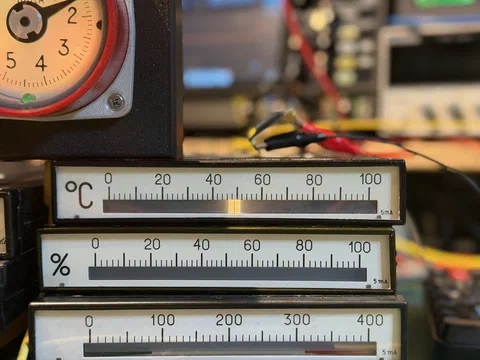
For the next steps: at the moment, the meters are just lying on my desk with a couple of wires and a microcontroller on top, while a separate power supply powers the lamp. I’m planning to 3D-print an adapter that will let me use addressable RGB LEDs as the light source instead – the original incandescent lamps do get rather warm. While the 3D printer is running, I’ll also make an enclosure for them, probably in something close to original Chornobyl-control-room grey, so I can mount them alongside the other control-room-device reinterpretations I’m working on.
So if you see my office and wonder: no, I do not have an RBMK reactor in the laundry room. I do have the instrumentation, though.