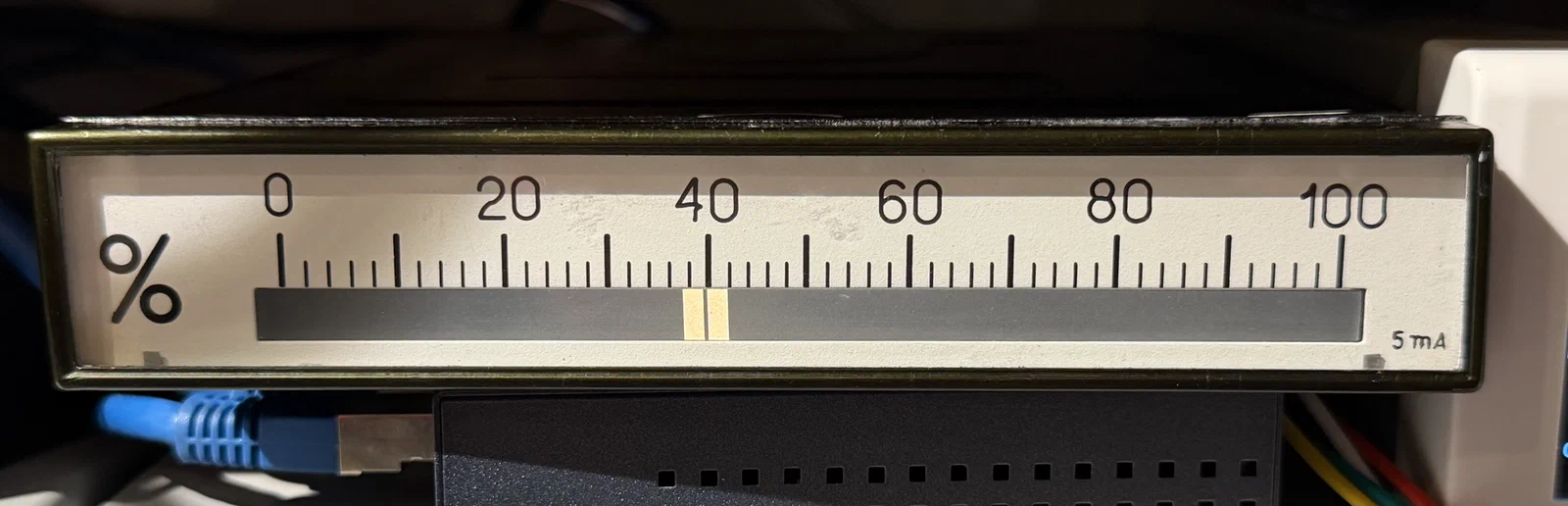
Where do I put this…
I wasn’t sure whether to tag this post with “Biel”, “Leningrad” or “Slavutych”. All three places are referenced on the map – I will explain my choices below.
There were hundreds of these things!
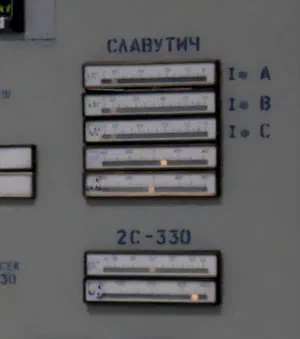
One of the things that struck me during my 2018 visit to the Chornobyl NPP was the interface design of the control rooms. While there were some digital elements (several VFD displays of Skala parameters and the Pyatachok), many instruments were still analogue. And a lot of those analogue instruments looked similar - a long rectangle with a value and a scale behind glass, and a light beam indicating the current value on the scale.
The Pyatachok, if you’re wondering, literally the “little five-kopeck coin”, was the RBMK reactor cartogram display, a circular-ish map of the core that let operators see what thousands of fuel channels and control rods were up to without having to mentally assemble a reactor from spreadsheet data.
This is a detail from ЦЩУ-1 - the central control room for the open switchgear and grid connection. These meters show data about the 330 kV line to Slavutych and related measurements. These instruments are everywhere, and they display everything from control rod insertion depth, reactor period (the time it roughly takes to double output power) to the number of neutrons passing through the ionization chamber during reactor startup and much more.
What intrigues me about this interface design is that it’s not just readable, but glanceable. A seven-segment number display has to be consciously read, and often compared mentally against a reference value or acceptable range. A line that is out of sync with the others, or sitting at the wrong end of its scale, can be noticed almost peripherally — before the operator has decoded a single number. If the operator does need the exact value of, say, LAR imbalance, the same instrument provides it.
As I discovered years later, this instrument, despite displaying everything up to and including the operator’s grandmother’s current mood, really only measures one thing.
Current.
The M1730 is a 5 mA full-scale moving-coil indicator. That’s it. Whether the face says 0–100%, neutron flux, rod position, or something more dramatic, the meter itself only sees current. The rest is translation.
Here’s how it works
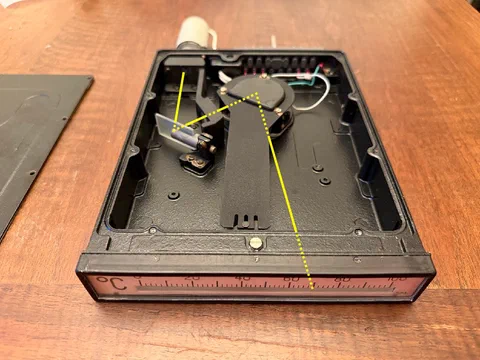
The meter has a light source at the rear, an ОП6-3-В5 incandescent bulb. The light is shaped by an optical assembly and mask into a rectangular image with a dark line through the centre. A fixed mirror directs this image onto a small mirror mounted on the moving galvanometer system. As the galvanometer deflects, the moving mirror steers the projected image across the frosted acrylic strip that forms the display.
Having already redesigned and built another part of Chornobyl’s instrumentation (the Selsyn indicator for control rods, published on Thingiverse), I wanted to make something resembling the M1730 as well.
While researching ways of mounting mirrors and shaping light beams, I had the obvious idea “Hey, why don’t I just buy one?” So I started looking for sources.
Where do I get one (or ten)
The first supplier, Zapadribor, listed them as “Price on request”. I asked them for a quote, would they ship to Switzerland and under what conditions. I’ll quote their entire reply here:
“€500”
Yeah, no. Too much.
Then I noticed someone on Etsy selling a “Chernobyl NPP Control Panel Ammeter M1730 for NPP version Control Panel RBMK Vintage”. At €60, that seemed a lot more reasonable, so I ordered one.
Immediately afterwards, of course, I started having second thoughts. I was fairly sure I had paid the “Chernobyl” surcharge (anything labelled Chernobyl is required to cost at least twice as much since the HBO series), plus the “RBMK” premium, the “vintage” markup, and probably a few other mysterious levies known only to Etsy sellers and customs officers.
Later, I would find out that the Etsy meter had not come from some separate mysterious RBMK antique pipeline at all. It had started from the same pile of boxed instruments I was about to find myself.
So, back to the internet. Searching for “М1730” instead of “M1730” gave me different results. Yes, these are two different search terms! The “M” in the first one is Cyrillic, the second one has a Latin “M”. This brought me to https://olx.ua - a Ukrainian classifieds site. One person there had the M1730 listed for 450 UAH - that’s about 9 euros!
If only I spoke Ukraini–oh, right. ChatGPT does. “Чи могли б ви розглянути можливість доставки до Швейцарії?” (I’ll continue in English…) “I’ll take ten”. The answer came back in Russian, which I learned back when the country was still called the Soviet Union: “Why do you want them? They don’t contain palladium!”
After a bit of back and forth on my awareness of the palladium content and which postal service would deliver to Switzerland (or rather my address in Germany), we agreed on a price: Ten units including shipping and handling for just a bit more than the price of two Etsy units. That sounded good.
I eventually managed to pay – the seller is unfortunate enough to have the same name as a Russian politician on the international sanctions list, which led to a panicked phone call from my bank.
There was still the question of whether they could actually be mailed. He was not convinced. I, however, now had a useful piece of evidence: the customs receipt from the Etsy meter, which proved that at least one obscure Soviet panel meter had already made the trip without causing an international incident.
That receipt had an unexpected side effect. The seller recognized the shipment details and realized that the Etsy seller had bought his units from him as well. So my “Chernobyl NPP Control Panel Ammeter M1730 for NPP version Control Panel RBMK Vintage” had not come from some separate antique pipeline after all. It had just taken the scenic route, with a hefty gift-shop markup.
A bit of nervosity remained as to whether the boxes would go through customs, so he announced he’d send them in two batches - this way, we wouldn’t lose the full consignment if there was a problem.
I have since received the first batch and made some discoveries that earn these meters a place on a website concerned with abandonment.
Going nuclear
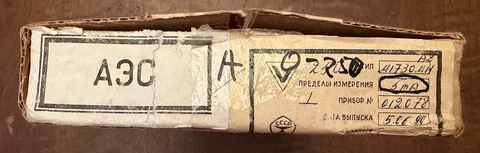
The reason the seller was worried about customs was a sticker on the boxes and the “passports” of the devices. The “passport” was the official booklet or document that came with a specific manufactured item in the Soviet Union. It identified that exact unit by model, serial number, factory, date of manufacture, technical specifications, quality-control stamps, warranty terms, included accessories, and sometimes repair, inspection, or calibration records.
The particular sticker read “АЭС”. This stands for атомная электростанция, nuclear power plant. I was quite surprised - on the one hand, a nuclear power plant is where I had first seen the devices, but I assumed they would be used in other control panels all over the place. Well, maybe this particular АЭС stood for something else.
Turned out it didn’t.
The seller had ripped the “АЭС” stickers off (the photo is from the Etsy unit). However, a look at the passport left no doubt that these were indeed produced, tested and certified for nuclear power plants.
In fact, the passports turned out almost more interesting than the devices themselves!
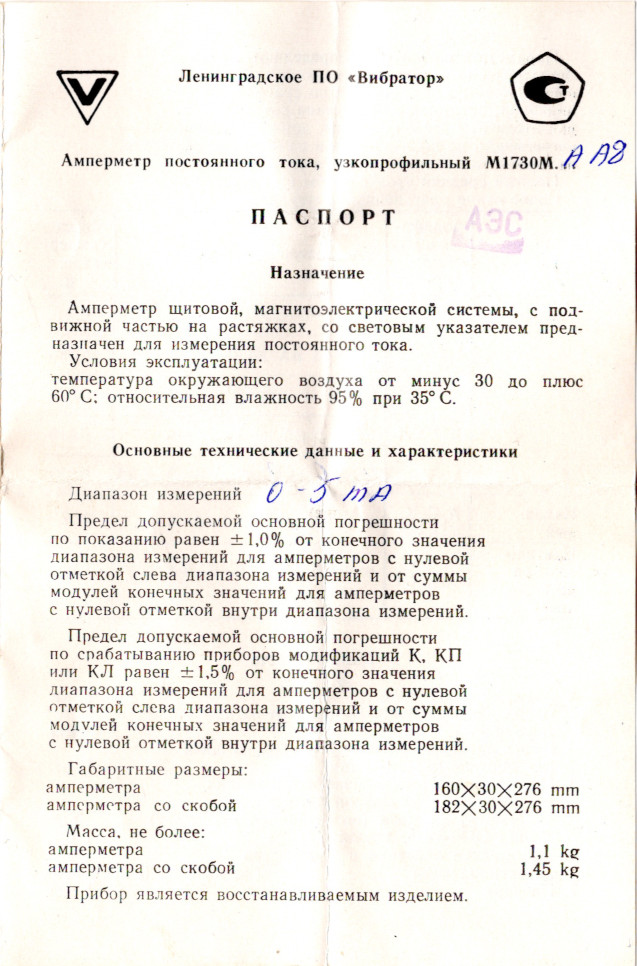
What can we learn from this page?
- This is a direct-current ammeter, narrow-profile, model M1730M, made by the “Vibrator” factory in Leningrad (This puts the “Leningrad” tag on the post)
- It measures 0-5 mA DC with an accuracy of 1%
- It is 160 × 30 × 276 mm big and weighs 1.1 kg without mounting bracket
- and it is a repairable device, not a disposable one.
Interestingly, the passport also has an “АЭС” stamp…
The inside of the passport finally tells us what the abbreviation stands for.
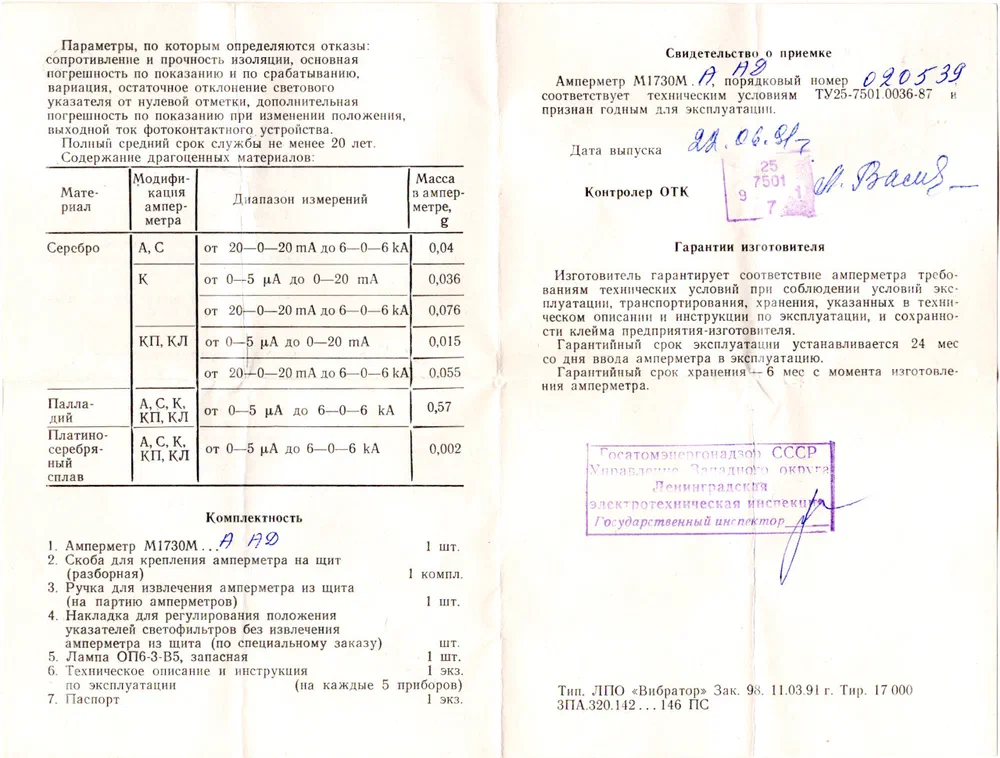
This tells us:
- the manufacturing date: 22.06.1991, one day after my 19th birthday
- the device has a warranty of 24 months from the date it is put into service, and a six-month storage warranty from the date of manufacture.
So the device is well out of warranty. It has been sitting in its box for almost 35 years!
The left page also has another interesting section. This one is about precious metals contained in the instrument. It lists materials such as silver, palladium, and platinum-silver alloy. My 5 mA version does not contain any palladium – but I knew that already from the seller’s chat, and the 0.035 grams of silver hardly make it worth breaking the devices open for profit.
The stamp on the right side removes all doubt as to whether the “АЭС” really stands for “nuclear power plant”:
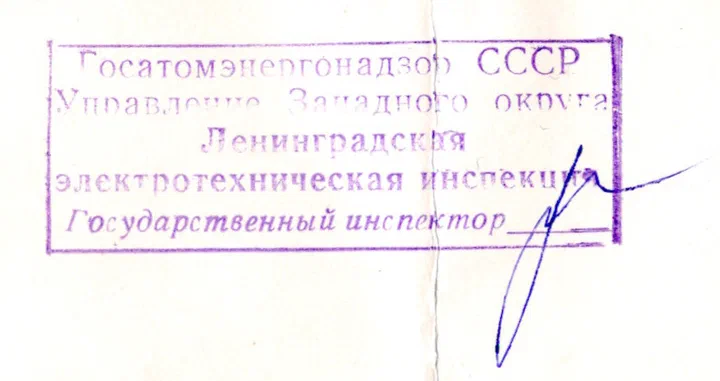
It is an official stamp of the (takes deep breath) Gosatomenergonadzor of the USSR. Seriously, nobody rocks abbreviations like the Soviet Union did! Gosatomenergonadzor was the “State Committee for the Supervision of Nuclear Power Safety”. So this meter was indeed checked and accepted for nuclear power plant use.
What makes this particularly interesting is that the seller lives in Slavutych, Ukraine (hence the second place marker). Slavutych was purpose-built after the 1986 disaster as the replacement city for Chornobyl Nuclear Power Plant workers and their families, after Pripyat was evacuated. So there is a possibility that these meters were originally planned to be put into service in the Chornobyl NPP.
The manufacture date is some years after the disaster, but at the time, the power plant was still generating power with three of its four reactors. Reactor 2 shut down in October of that year after a fire in the turbine hall.
They never made it to whatever plant they were going to. Instead, they stayed in storage. They survived the end of the Soviet Union, the independence of Ukraine, the Orange Revolution and the start of the Russian war.
On December 15, 2000 at 13:17, Unit 3, the last operating reactor, was permanently shut down. The demand for panel-mounted ammeters certified for nuclear power plants did not exactly improve. They waited: 26 years after the last reactor shut down, 35 years since they were manufactured…
…until some bloke from Switzerland decided to use them as display units for his smart home. This, at last, explains “Biel” on the map markers.